
Legal Requirements for Building a Pool in Pompano Beach: A Homeowner’s Guide
Are you planning to transform your backyard into a tropical oasis? Building a swimming pool in Pompano Beach, Broward County, is an exciting project, but it involves navigating a complex landscape of local regulations and Florida state laws.
At Accro GC, we specialize in managing the entire process—from the first blueprint to the final inspection. To help you get started, here is a comprehensive look at what you legally need to secure your pool permit in Pompano Beach.
1. The “One Permit” Concept in Pompano Beach
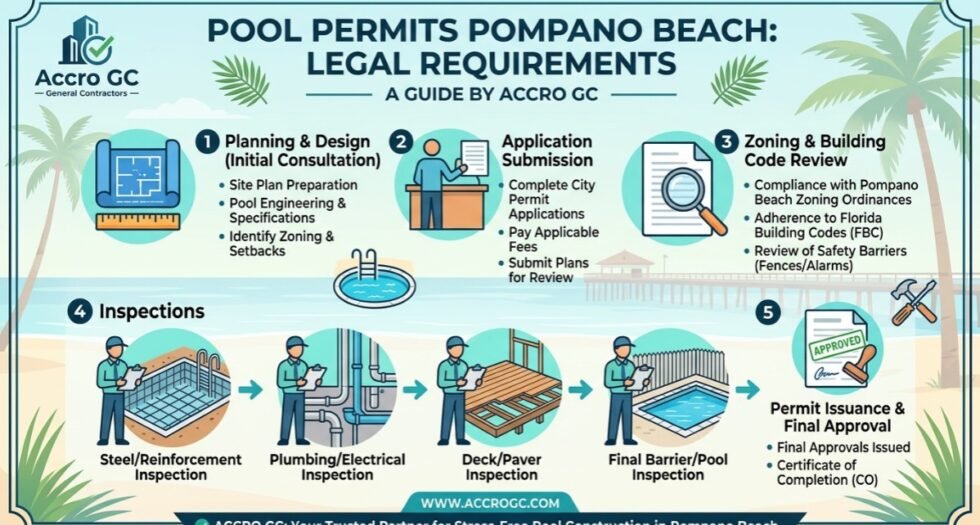
Unlike other jurisdictions, Pompano Beach operates under a “one permit” system. This means that while your project involves structural, electrical, and plumbing work, these are typically bundled into a single master permit. This streamlines the process but requires a highly detailed initial submission.
2. Essential Documentation for Your Application
To apply for a residential swimming pool permit, the City of Pompano Beach and Broward County require the following:
- Broward County Uniform Building Permit Application: Signed and notarized by both the homeowner and the licensed contractor.
- Recent Property Survey: Typically must be less than one year old. It must show all existing structures, easements, and the proposed location of the pool.
- Signed and Sealed Plans: Two sets of engineering plans (structural, plumbing, and electrical) prepared by a Florida-registered architect or engineer.
- Geotechnical/Subsoil Report: Necessary to ensure the ground can support the pool’s structure, especially in coastal areas like Pompano Beach.
- Drainage & Grading Plan: You must prove that rainwater runoff will be retained on your property and won’t negatively impact your neighbors.
3. Compliance with the Florida Residential Swimming Pool Safety Act
Under Chapter 515, Florida Statutes, every new pool must have at least one safety feature to prevent drowning. In Pompano Beach, you must sign an affidavit selecting your method of protection, such as:
- A Pool Barrier: A fence at least 4 feet high with self-closing, self-latching gates that open outward.
- Safety Covers: An approved manual or power-operated safety cover.
- Exit Alarms: Alarms on all doors and windows with direct access to the pool area.
- Self-Closing Devices: On all doors providing direct access from the home.
4. Key Setbacks and Zoning Rules
In Pompano Beach, a pool is considered an “accessory structure.” General rules include:
- Distance from Property Lines: Most residential pools must be at least 5 feet from the side and rear property lines (measured from the water line).
- Easements: You cannot build a permanent structure over utility easements without specific encroachment agreements from each utility provider.
5. The Notice of Commencement (NOC)
If your pool project is valued at $5,000 or more (which most are), Florida law requires you to file a Notice of Commencement with the Broward County Records Division. This document protects your property’s title and must be recorded before your first inspection can be scheduled.
Why Choose a Licensed Contractor Like Accro GC?
Attempting to pull “Owner-Builder” permits places all legal and safety liability on you. Hiring Accro GC ensures that:
- All work meets the Florida Building Code (FBC).
- Inspections (Soil, Steel, Plumbing, Electrical, and Final) are handled professionally.
- Your project stays compliant with Pompano Beach’s specific zoning ordinances.