
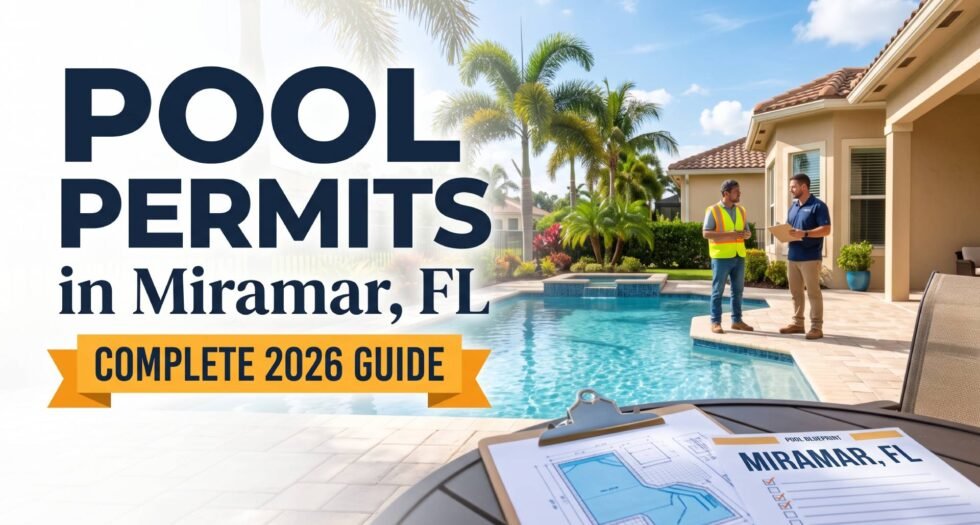
Quick Answer: Do You Need a Permit to Build a Pool in Miramar, FL?
Yes. The City of Miramar requires a building permit for a swimming pool or spa, plus a separate permit for the required safety barrier. A Florida-licensed engineer or architect must sign and seal the plans, and you submit them through the city’s online permitting portal. The city says residential permits usually take about 15 business days to issue. The city bases its fees on the cost of construction: a 1.75% permit fee and a 0.75% plan review fee, plus an 8% city surcharge and county and state fees. In addition, if you hire a contractor, that contractor must pull the permit. Finally, you cannot fill or use the pool until the safety barrier has passed final inspection.
This guide walks Miramar homeowners through the documents, steps, inspections, fees and timeline, using the City of Miramar’s own published requirements and Florida law. Every source is linked at the bottom so you can verify it.
Key Facts at a Glance
| Item | Miramar requirement |
|---|---|
| Permitting authority | City of Miramar Building Division, 2200 Civic Center Place, Miramar, FL 33025 · 954-602-3200 |
| How to apply | Online through the city’s permitting portal |
| Who can apply | A licensed contractor registered with the Building Division, or an owner-builder (residential only) |
| Plans | Signed and sealed by a Professional Engineer or Registered Architect |
| Survey | Original signed and sealed boundary survey less than 7 years old |
| Plan review departments | Planning & Zoning, Engineering, Landscaping, Plumbing, Electrical, Structural/Building |
| Typical timeline | About 15 business days for residential projects (city estimate) |
| Core fees | 1.75% permit fee + 0.75% plan review + 8% surcharge + Broward County and Florida fees |
| Safety barrier | Separate permit, minimum 4 feet high, must pass final inspection before the pool is filled |
| Building code | The city states that applications submitted on or after January 1, 2024 are reviewed under the Florida Building Code, 8th Edition (2023) |
Which Pool Projects Need a Miramar Permit?
The city’s Swimming Pool & Spa application package covers new pools and spas, and Miramar requires separate trade permits for electrical work, plumbing, pools, heaters and similar items. In practice, a new in-ground gunite pool involves several permits that move together: building (structural), electrical, plumbing, and the safety barrier. Under Florida’s Residential Swimming Pool Safety Act, a “swimming pool” includes any residential structure intended for swimming or recreational bathing that holds water more than 24 inches deep, including in-ground, above-ground and on-ground pools, hot tubs and non-portable spas.
Because scope matters (a heater, a cover, a new deck or a remodel can each trigger different permits), call the Building Division at 954-602-3200 before starting. The city asks residents to do this before any home improvement project.
Who Can Pull the Permit in Miramar?
Option A: A licensed contractor. The city issues the permit to a licensed contractor who is properly registered with the Building Division and has current licenses and insurance on file. Contractor registration updates go to ContractorUpdates@miramarfl.gov. You can confirm any contractor’s license status at the Florida DBPR license search.
Option B: The homeowner (owner-builder, residential only). First, the city requires a photo ID matching the project address, proof of ownership (such as a recorded warranty deed, tax statement or settlement statement), and confirmation of the Homestead Exemption. An owner-builder must also sign a disclosure statement acknowledging that they are legally and financially responsible for the work, must supervise it on site, and may face liability for injuries to unlicensed workers, which homeowner’s insurance may not cover.
Important: if you hire a contractor, the contractor must pull the permit. In other words, treat any request for the homeowner to pull the permit on a contractor’s behalf as a red flag.
Documents Checklist for a Miramar Pool Permit
Based on the city’s current Swimming Pool & Spa application package (revision 01/25):
Plans and Property Documents
- Permit applications for each trade in scope (structural, plumbing, electrical and so on), using the Broward County Uniform Building Permit Application, notarized.
- Plans: one original set signed and sealed by a Professional Engineer or Registered Architect, no larger than 11” x 17”. Larger plans require two sets.
- Boundary survey: original, full-scale, signed and sealed by a Professional Land Surveyor, less than 7 years old. The city does not accept reduced, faxed, enlarged or altered surveys.
- Specifications for applicable pool safety items (alarms, covers, heat pump and similar).
- Digital submittals: documents must be in true PDF format (the city rejects photos converted to PDF). Digitally sealed plans also need the Affidavit of Identical Documents.
- Job value (labor and materials) for permit valuation.
Affidavits and Required Forms
- Affidavit of Awareness of Homeowner’s Association Regulations. Required even if your property is not in an HOA.
- Construction Debris Removal Affidavit. City code requires Waste Pro, the city’s trash vendor, to haul construction debris.
- Safety Barrier Affidavit and the Residential Swimming Pool, Spa & Hot Tub Safety Act affidavit, which the owner and the prime contractor both sign.
- Site Drainage Provision Disclosure Statement, which the owner and the primary contractor both sign.
- Recorded Notice of Commencement if the work exceeds $5,000. Keep it on hand for the first inspection.
- Owner/Builder Disclosure Statement, only if the homeowner is pulling the permit.
All forms are in the city’s Swimming Pool & Spa application package, and more are listed on the Applications & Forms page.
Step-by-Step: How to Get a Pool Permit in Miramar
- Choose a licensed, city-registered pool contractor (or confirm you qualify as an owner-builder). Verify the license with DBPR.
- Finalize the design and engineering. Your plans need a Florida PE or RA seal, a current boundary survey and the specs for your safety features.
- Prepare the forms and affidavits listed above. A notary must witness several of them, and contractors can use any notary. Homeowner-builders can ask the permit clerk to notarize the HOA affidavit if they appear in person with ID and proof of ownership.
- Record the Notice of Commencement with Broward County if the project exceeds $5,000. See the Broward County Notice of Commencement page.
- Submit through the online portal and pay the application fees, which are due at submittal.
- Plan review. Miramar reviews pool plans through Planning & Zoning, Engineering, Landscaping, Plumbing, Electrical and Structural/Building. Depending on scope, other agencies may also need to approve the plans.
- Permit issuance. The city’s typical turnaround for residential projects is about 15 business days. However, complex or incomplete submittals take longer.
- Pull the separate safety barrier permit and schedule inspections as construction progresses.
- Pass final inspections (building, electrical, plumbing, engineering drainage and grading, and the barrier) before filling the pool.
Pool Safety Barrier Rules in Miramar
Miramar adds local requirements on top of state law, and the city rejects the final pool inspection if the required barrier is missing or unapproved.
What Miramar Requires
In the city’s Safety Barrier Affidavit, the owner agrees not to use or fill the pool until the city has issued a separate permit for an approved safety barrier and the barrier has passed final inspection. The affidavit cites Miramar’s Land Development Code and states that the barrier must stand at least 4 feet high and enclose the area entirely, with spring-lock gates that close automatically and a self-latching lock. It lists the barrier forms as a screened-in patio, a wooden fence or a concrete block wall. However, if you prefer another fence material, confirm with the Building Division before you design around it.
What Florida Law Requires
Under Chapter 515, Florida Statutes, a residential pool must meet at least one of these safety features to pass final inspection:
- an enclosure isolating the pool from the home that meets the barrier standards of section 515.29,
- an approved safety pool cover,
- exit alarms on all doors and windows with direct access from the home to the pool (minimum 85 dBA at 10 feet),
- self-closing, self-latching devices on all doors with direct access, with the release at least 54 inches above the floor, or
- a pool alarm certified to ASTM F2208.
Barrier Standards Under Section 515.29
A barrier under section 515.29 must stand at least 4 feet high on the outside, have no gaps or climbable features a young child could use, and sit far enough from the water’s edge to keep a child who gets through from falling straight in. In addition, gates must open outward, away from the pool, and must be self-closing and self-latching, with the release on the pool side out of a young child’s reach. Finally, failing to equip a new residential pool with at least one safety feature is a second-degree misdemeanor.
Choosing Your Safety Method
Miramar’s Residential Swimming Pool, Spa & Hot Tub Safety Act affidavit asks you to initial the method you will use. Your options are an ASTM F1346 safety cover, a continuous one-piece child barrier under Florida Building Code R4501.17, an enclosure isolating the pool from the structure, or UL 2017 exit alarms and an ASTM F2208 pool alarm.
Engineering, Drainage and Grading Requirements
Miramar’s Engineering Services group sets these pool-specific rules:
- Plans must include a site grading plan showing that surface drainage along property lines will not change and will not harm neighbors, with existing and proposed elevations and cross-sections along property lines.
- Plans must include notes requiring a site inspection with Engineering before excavating and grading, and stating that crews will not place fill along property lines or drainage swales.
- Final engineering inspection requires a certified survey, from a Florida-licensed surveyor, with final grade elevations.
- City code requires rainwater to stay on your property. Runoff may not flow onto or across adjoining property or sidewalks unless the engineering department approves discharge to a street gutter or storm drain.
Finally, schedule engineering inspections Monday through Thursday by calling 954-602-3304 with 48 hours’ notice.
Required Miramar Pool Inspections
The city’s application package lists these inspections for a pool or spa. Depending on your scope, the city may require other inspections, and the sequence on your project may vary.
| Code | Inspection | Notes |
|---|---|---|
| E110 | Clearing & grubbing | Engineering. Required before pool steel |
| B168 | Pool/spa steel | A soil statement from the designer may be required first |
| B229 | Pool bond | |
| B233 | Underground rough | |
| B251 | Equipotential bonding | |
| B431 | Main drain | |
| B432 | Pool/spa piping | |
| B170 | Patio/deck/slab | Pool deck inspection |
| B910 | Final electrical | |
| B931 | Final plumbing | |
| E410 | Drainage & grading | Engineering. Required before final building |
| B999 | Final building/pool |
Building inspections run Monday through Thursday, 8:00 a.m. to 3:00 p.m. You can request an AM or PM window, though it is not guaranteed. Schedule through the portal, where you must be registered and listed as a contact on the permit. The city posts daily inspection times online.
The pool steel inspection covers the rebar reinforcement in your pool shell. For why that matters, read our guide on why pools crack and the role of concrete and rebar.
Miramar Pool Permit Fees (2026)
The city’s FY 2026 Schedule of User Fees (adopted September 17, 2025) sets these building fees:
- Permit fee: 1.75% of the cost of construction, with a $75 minimum per residential application per discipline.
- Plan examination fee: 0.75% of estimated construction cost, covering the initial review plus two reviews after corrections. After the third review, a $500 flat fee per discipline applies.
- Administrative surcharge: 8% on building fees.
- Broward County fee: the greater of $2 or $0.52 per $1,000 of construction value.
- Florida state fees: 1.5% (Building Code Administrators and Inspectors Fund) and 1.0% (DBPR surcharge) of permit fees, each with a $2 minimum.
- Engineering Services: the schedule lists $250 for a residential pool.
- Re-inspections: $80 for the first and second re-inspection of the same type, and more after that.
- Expedited plan review: $300 per discipline for residential.
- Notary service at the city: $10 per page.
Estimating Your Total Cost
For scale, a 1.75% permit fee on $10,000 of valuation is $175, before surcharges and other fees. Because you apply for each discipline separately and the Building Official sets the final valuation, ask the Building Division for a fee estimate on your specific project. Fees are non-refundable, and the schedule adjusts automatically each October 1 (by the lesser of 3% or the CPI change), so always check the current Schedule of User Fees (building fees are on pages 4 and 5).
How Long Does a Miramar Pool Permit Take?
The City of Miramar says it usually takes approximately 15 business days to issue a residential permit. However, review time depends on how complete your submittal is. Incomplete packages can stall review, so check for an outdated survey, plans larger than 11” x 17”, files that are not true PDFs, a missing grading plan, a missing HOA awareness affidavit and an unrecorded Notice of Commencement. A complete package on the first try is the fastest route to approval.
HOA Approval Is Separate From the City Permit
Miramar’s Affidavit of Awareness states that a city permit does not exempt you from your HOA’s rules, and an HOA can add regulations or deny the work even after the city issues a permit. Therefore, get HOA approval in writing before you finalize the design.
What Happens If You Build Without a Permit?
Miramar’s fee schedule lists double the permit fee for work started without a permit, and Engineering Services lists a $500 fine plus a doubled permit fee when work requiring an engineering permit begins before you secure the permit. Separately, failing to provide a required pool safety feature under Florida law is a second-degree misdemeanor. Unpermitted work can also complicate the sale of your home.
Why Work With a Licensed Pool Contractor in Miramar
The permit process involves engineering, six review groups, multiple affidavits and a dozen inspections. A licensed, city-registered contractor handles the filing, coordinates the inspections and takes legal responsibility for the permit, which protects you from the owner-builder liabilities described above.
Accro GC is based right here in Miramar at 3350 SW 148th Ave, Suite 110, and builds custom gunite pools across Broward County. To see how a project is built from excavation to finish, read our Gunite Pool Construction step-by-step guide. To budget realistically, see The Real Cost to Build a Gunite Pool in South Florida and our financing options. Considering a builder? Read what to look for in a top-rated Miramar pool contractor and how to choose the best pool contractor in Miramar.
Ready to start? Request a free estimate or call (954) 934-3379.
Building a Pool Elsewhere in Broward County?
Permit rules differ by city. See our local guides for Hollywood, Pembroke Pines, Pompano Beach, Davie and Weston, or learn about our county-wide pool construction services.
Frequently Asked Questions
Do I need a permit to build a pool in Miramar, FL?
Yes. Miramar requires a building permit for pools and spas, trade permits as applicable, and a separate permit for the safety barrier.
How long does it take to get a pool permit in Miramar?
The city estimates about 15 business days for residential projects. However, incomplete submittals take longer.
How much is a pool permit in Miramar?
The permit fee is 1.75% of construction cost, plus a 0.75% plan review fee, an 8% surcharge, and Broward County and Florida state fees. Engineering lists $250 for a residential pool. Because the city adjusts fees each October 1, confirm current amounts with the Building Division.
Can a homeowner pull a pool permit in Miramar?
Residential owner-builders can, with a photo ID, proof of ownership, Homestead Exemption verification and a signed disclosure statement. However, if you hire a contractor, that contractor must pull the permit.
Do I need a survey for a Miramar pool permit?
Yes. You need an original signed and sealed boundary survey less than 7 years old. In addition, the final engineering inspection requires a certified survey with final grades.
When can I fill my pool in Miramar?
Not until the separate safety barrier permit has had a final inspection and passed, per the city’s Safety Barrier Affidavit.
Do I need a Notice of Commencement?
Yes, if the construction value exceeds $5,000. Record it with Broward County and keep it available for the first inspection.
Does HOA approval replace a city permit?
No. They are separate. A city permit does not override HOA rules, and HOA approval does not replace the city permit.
Sources and Verification
This guide is informational and is not legal advice. Requirements change, so confirm details with the City of Miramar Building Division at 954-602-3200 before you apply.
- City of Miramar: Building Permits & Inspections
- City of Miramar: Permitting portal (EnerGov Self Service)
- City of Miramar: Swimming Pool & Spa Application Package (Rev. 01/25)
- City of Miramar: Applications & Forms
- City of Miramar: FY 2026 Schedule of User Fees
- City of Miramar: City Code & Land Development Code
- Florida Statutes, Chapter 515: Residential Swimming Pool Safety Act (2026)
- Broward County ePermits: Notice of Commencement
- Florida DBPR: Verify a license
- Waste Pro of Florida