
We’ve all seen it. A beautiful backyard pool, the kind with a perfect tile line and a waterfall feature, develops a hairline crack across the deck within a couple of years. Or worse, the shell shifts and starts leaking. It’s hard to watch, especially when the finish looked flawless on installation day.
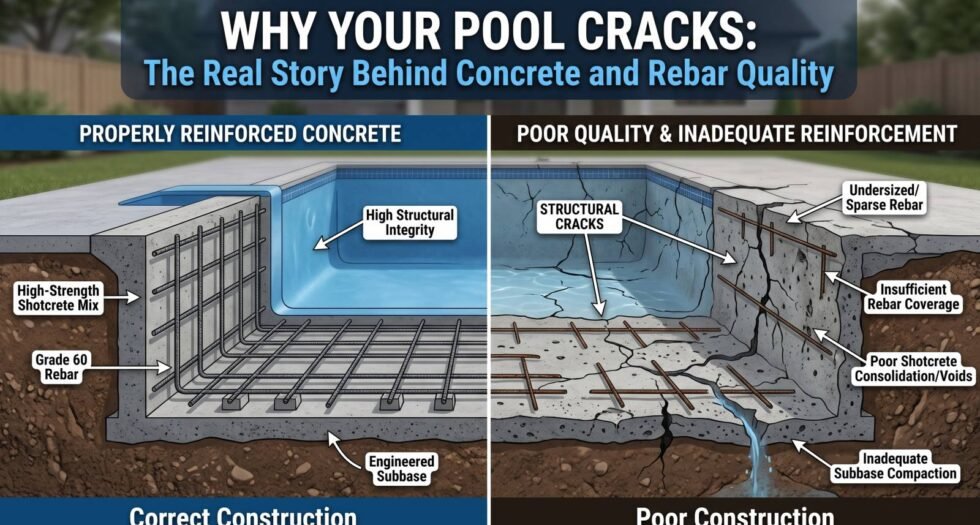
Here’s the truth nobody puts on the sales brochure: a pool’s real quality hides where you can’t see it. Everyone falls in love with the tile, the coping, and the lighting. But the concrete mix and the steel reinforcement, working together as one structural system, actually keep a pool standing for 30, 40, or even 50 years.
We’ve built pools across Broward County for more than 20 years, and we’ve dug up more failed shells than we can count. Almost every failure traces back to the same root cause: a cement-to-steel relationship that engineers never designed to handle the forces a pool actually experiences.
A Pool Is a Structure First, a Feature Second
It’s easy to forget that a swimming pool isn’t just a decorative hole in the ground. It’s a load-bearing concrete structure, and it holds back two aggressive forces at the same time:
- Hydrostatic pressure: thousands of gallons of water push outward against the walls and floor, 24 hours a day, every day of the year.
- Soil and groundwater pressure: the ground pushes back in from the outside, and this matters even more here in South Florida, where the water table sits close to the surface.
- Thermal expansion and contraction: South Florida swings between blistering summer heat and cooler winter nights, and this constant cycle makes the shell expand and contract in small but relentless movements.
- Ground movement: nearby construction, drainage changes, and the sandy, sometimes inconsistent soils throughout Weston, Davie, and Miramar can all shift a shell over time.
None of these forces show up on a rendering. Instead, they surface five, ten, or fifteen years later as a crack, a leak, or a shell that slowly pulls apart. That’s why the engineering beneath the water matters more than anything you’ll see above it.
Concrete Strength: Not All Mixes Are Built the Same
Builders typically spray pool shells with gunite or shotcrete, and they measure the strength of that mix in PSI (pounds per square inch). This single number has a huge impact on how long a shell can withstand constant water pressure and soil movement.
| Concrete Mix Grade | Typical PSI Rating | Where It’s Commonly Used | Long-Term Performance |
|---|---|---|---|
| Minimum industry mix | ~2,500–3,000 PSI | Budget builds, high-volume production pools | Meets bare code minimums; leaves little margin for workmanship variance or harsh soil |
| Standard quality mix | ~3,500–4,000 PSI | Most reputable residential pool construction | Provides a solid structural margin for typical Florida conditions |
| High-density / premium mix | ~4,500–5,000+ PSI | High-sulfate soils, sloped lots, vanishing edges, commercial pools | Offers the best resistance to cracking, corrosion, and long-term settling |
The lesson here isn’t “bigger number always wins.” Instead, the PSI rating has to match the soil, the site, and the design. For example, a vanishing-edge pool on a sloped Southwest Ranches lot needs a very different mix than a straightforward rectangular pool on flat, stable ground in Cooper City. So when a contractor specs the same mix for every job, regardless of site conditions, they’re cutting corners you won’t notice until it’s too late.
Steel Reinforcement: The Skeleton Inside the Skin
Concrete handles compression well but struggles under tension, and that’s exactly the gap rebar fills. The steel cage inside a pool shell lets the structure flex slightly under pressure instead of cracking. Get the size, grade, or spacing wrong, though, and you end up with a shell that looks solid but has no real backbone.
| Rebar Factor | Common Industry Standard | Why It Matters |
|---|---|---|
| Bar size | #3 to #4 rebar (3/8″ – 1/2″) | Larger bars can cause “shadowing,” meaning voids form behind the steel where sprayed concrete can’t fully wrap around it |
| Spacing | 8″–12″ on center, running both directions | Tighter spacing without a matching increase in shell thickness offers little real benefit and can trap air pockets |
| Grade | Grade 40 or Grade 60 steel | Grade 60 delivers roughly 50% more tensile strength than Grade 40, so never accept ungraded or “mystery” steel |
| Bond beam reinforcement | Extra bars around the top perimeter | The bond beam absorbs the most stress in the entire structure, so engineers usually recommend reinforcing it first |
| Concrete cover | 2″–3″ clearance around each bar | Insufficient cover exposes rebar to moisture, and that moisture eventually causes corrosion, expansion, and spalling (cracked, popped concrete) |
Most homeowners never get to inspect this part of the process closely, and that’s exactly why some builders cut costs here first. However, a pool built with the correct steel cage and PSI mix, sprayed monolithically as one continuous shell, becomes a fundamentally different structure than one where corners were cut before the water ever went in.
Why This Matters More in South Florida
Broward’s climate and soil conditions make the cement-to-steel relationship even more critical than in most parts of the country:
- High water tables across Davie, Plantation, and Sunrise increase hydrostatic pressure against pool walls year-round.
- Sandy, variable soils throughout Miramar and Pembroke Pines shift more than denser clay soils, so they place extra strain on a shell that lacks adequate reinforcement.
- Intense heat cycles push South Florida shells through constant thermal expansion and contraction, and a properly engineered mix and steel cage are built to absorb that stress.
- Hurricane season groundwater surges can add sudden pressure spikes around a shell that hasn’t fully cured or was under-reinforced from the start.
We build this kind of site-specific engineering into every project across our Broward service area, including Weston, Davie, Miramar, Cooper City, Southwest Ranches, and Fort Lauderdale.
What This Means for You as a Homeowner
You don’t need to be a structural engineer to ask the right questions before signing a contract. Instead, ask any contractor these four questions:
- What PSI concrete mix are you using, and is it specified for my soil conditions?
- What rebar size, grade, and spacing appear in the structural plans?
- Do you spray the shell monolithically, or do you pour the floor and walls separately?
- Has a licensed structural engineer certified the plans for my specific lot?
A trustworthy contractor answers these without hesitation, because the answer already sits in their engineered plans, not just in a sales pitch.
Built to Outlast the Trend, Not Just the Photo
Beautiful finishes fade in and out of style, but a properly engineered shell doesn’t care about trends. It just holds. We’ve built pools throughout Broward County for more than 20 years, and our approach always starts below the surface, long before the first tile ever gets set.
So if you’re planning a new pool, or you simply want a second opinion on a structural proposal you’ve received, our team is happy to walk through the engineering with you. You can request a free estimate for a site-specific look at your project, explore flexible financing options to make a properly engineered pool more accessible, or get in touch with our team with any questions about your soil, your site, or your structural plans.
Further Reading
If you want to go deeper into the engineering side of pool construction, check out these two independent industry resources:
- Shooting for Strength — Pool & Spa News takes a closer look at how the industry sets PSI strength standards for gunite and shotcrete pools.
- Reinforcement Spacing in Gunite & Shotcrete Pools — Pool Engineering, Inc. breaks down common myths around rebar spacing, straight from a structural engineer.
Frequently Asked Questions
Why do pools crack even when they look well-built? Cracking is almost always a structural issue rooted in the concrete mix or steel reinforcement, not the visible finish. So even if the tile and coping look perfect on day one, a shell with the wrong PSI rating for the soil, or with rebar that’s undersized, poorly spaced, or lacking sufficient concrete cover, will eventually crack under constant hydrostatic pressure and thermal cycling.
What PSI concrete should a Florida pool use? Most reputable Florida pool builders use a minimum of 3,500–4,000 PSI, and they recommend 4,500+ PSI for high-sulfate soils, sloped lots, or vanishing-edge designs. Ultimately, the right number depends on your specific soil and site conditions.
Does more rebar always mean a stronger pool? Not necessarily. Builders have to match reinforcement to shell thickness and concrete mix. Otherwise, tighter spacing without a thicker shell offers little real structural benefit, and the bond beam and correct grade of steel matter more than simply adding extra bars.
How long should a properly built gunite pool last? A pool built with the correct PSI mix, properly graded and spaced rebar, and adequate concrete cover can structurally last 30–50 years or more. That’s well beyond the lifespan of a shell built to bare minimum specifications.